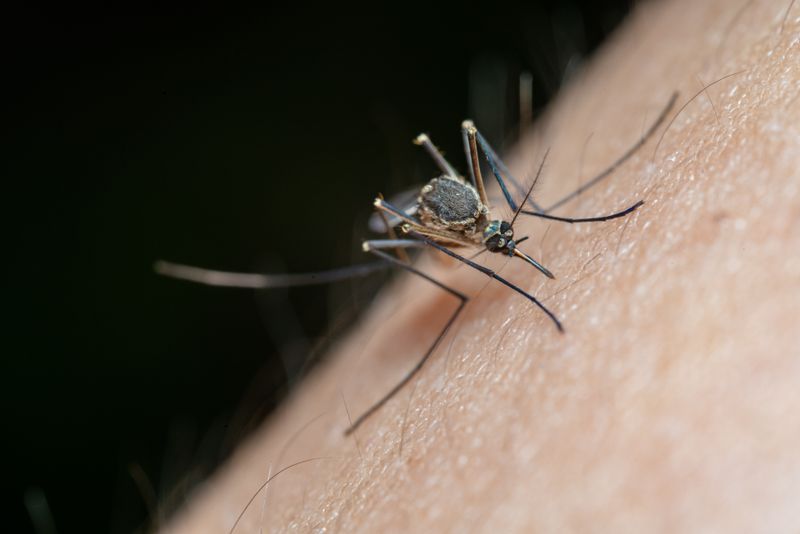
The Problem
Mosquitoes kill more humans than any other animal on earth. They ruin backyard barbecues, keep you up at night, and transmit diseases across six continents. Chemical sprays are temporary. Citronella candles are decorative at best. Bug zappers kill everything except mosquitoes (studies show they mostly attract and kill beneficial insects).
The No-Mo takes a different approach: detect the mosquito by its acoustic signature, then eliminate it. No chemicals, no collateral damage, no mercy.
The Science
Every mosquito species has a distinctive wing beat frequency — the rate at which its wings oscillate in flight. This produces the characteristic whine you hear at 2 AM. That sound is a fingerprint.
| Species | Wing Beat Frequency | Region |
|---|---|---|
| Aedes aegypti (Yellow Fever) | 450–600 Hz | Tropical / Southern US |
| Aedes albopictus (Asian Tiger) | 350–500 Hz | Eastern US / Global |
| Culex pipiens (Common House) | 300–450 Hz | Worldwide |
| Anopheles gambiae (Malaria) | 350–500 Hz | Sub-Saharan Africa |
| Housefly (not a mosquito) | 190–200 Hz | — |
| Honeybee (not a mosquito) | 200–250 Hz | — |
The key insight: mosquitoes occupy a higher frequency band (300–600 Hz) than most other common flying insects. A microphone, a fast Fourier transform, and some filtering can reliably distinguish a mosquito from a fly, bee, or moth. Research teams have demonstrated 80%+ species-level accuracy using this method on low-power embedded hardware.
Choose Your Approach
Tier 1: Detect + Alert
Mic array detects mosquito presence and lights up an LED or sends a phone notification. Simplest build — no moving parts, no kill mechanism. Pure detection proof-of-concept.
Tier 2: Detect + Trap
Detection triggers a fan trap or UV lure to activate only when mosquitoes are present. Energy-efficient — the trap only runs when there's something to catch.
Tier 3: Detect + Track + Eliminate
Acoustic triangulation or camera tracking to pinpoint the mosquito's position, then a focused response — laser, directed air blast, or precision fan. The Photonic Fence approach, scaled down to a porch.
What You Bring
The kit includes the microphone array, frequency analysis board, and trap hardware. You supply:
- Raspberry Pi 4 / 5 — runs FFT analysis and trap control logic
- microSD card — 16GB recommended
- USB power supply — 5V/3A for the Pi
- Box fan or 120mm PC fan — for the intake trap (Tier 1 build)
- Enclosure — weatherproof box if deploying outdoors (plastic tub works)
What's Included in the BYOB Kit
- Dual MEMS microphone array (I2S digital output)
- 80mm intake fan with 3D-printed funnel
- Mesh capture bag with quick-release mount
- MOSFET trigger board for fan control
- UV LED lure strip with driver circuit
- Weatherproof enclosure
- Pre-crimped wiring harness with labeled connectors
- Complete source code, wiring diagrams, and setup documentation
What You Bring
The Full Send Kit includes all electronics and hardware. You supply:
- Box fan or 120mm PC fan — for the intake trap (Tier 1 build)
- Enclosure — weatherproof box if deploying outdoors (plastic tub works)
What's Included in the Full Send Kit
- Raspberry Pi 4B — pre-loaded with FFT analysis software
- 16GB microSD card — pre-imaged with Raspberry Pi OS and kit software
- USB-C power supply (5V/3A)
- Dual MEMS microphone array (I2S digital output)
- 80mm intake fan with 3D-printed funnel
- Mesh capture bag with quick-release mount
- MOSFET trigger board for fan control
- UV LED lure strip with driver circuit
- Weatherproof enclosure
- Pre-crimped wiring harness with labeled connectors
- Complete source code, wiring diagrams, and setup documentation
What You Bring
Plug in power and place in your yard. Acoustic FFT detection starts automatically.
- Outdoor power outlet or extension cord — for the unit
What's Included — Ready to Use
- Complete mosquito detection and trapping unit in weatherproof enclosure
- Raspberry Pi 4B — pre-loaded with FFT analysis software
- 16GB microSD card — pre-imaged with Raspberry Pi OS and kit software
- USB-C power supply (5V/3A)
- Dual MEMS microphone array (I2S digital output)
- 80mm intake fan with 3D-printed funnel
- Mesh capture bag with quick-release mount
- MOSFET trigger board for fan control
- UV LED lure strip with driver circuit
- Weatherproof enclosure
- Pre-crimped wiring harness with labeled connectors
- Complete source code, wiring diagrams, and setup documentation
Every Zero Shot unit is hand-assembled, firmware-loaded, sensor-calibrated, and QA tested before shipping. Premium boxed packaging included.
Project Files — Included with BYOB Kit
Complete source code, wiring diagrams, and documentation. Enter your kit code to unlock.
Don't have a code? Get the kit — code included in every box.
Step-by-Step
Set Up Audio Capture
Wire your MEMS mic to the Pi. For the I2S SPH0645 breakout:
# Enable I2S on the Pi
# Add to /boot/config.txt:
dtparam=i2s=on
// ... full implementation in project files
For analog mics (MAX4466), connect the output to a USB sound card's mic input. Simpler wiring, slightly noisier signal.
Real-Time FFT Detection
The core of the No-Mo is a continuous frequency analysis loop. Capture short audio windows, run an FFT, and look for energy spikes in the mosquito band:
import numpy as np
import pyaudio
from scipy.signal import butter, lfilter
// ... full implementation in project files
Build the Fan Trap
The trap is simple: a funnel that concentrates airflow into a mesh bag, powered by a PC fan. When a mosquito is detected, the fan spins up and creates a downdraft that pulls the mosquito into the bag where it dehydrates.
- Mount an 80mm or 120mm PC fan blowing inward (pulling air through the intake)
- Attach a funnel or cone to the intake side — a cut-down plastic bottle works well
- Behind the fan, mount a fine mesh bag (pantyhose material works perfectly) to catch trapped insects
- Optional: mount UV LEDs around the funnel opening as an attractant
# Fan control via MOSFET
import RPi.GPIO as GPIO

// ... full implementation in project files
Add the Lure (Optional but Effective)
Mosquitoes find hosts primarily through CO2, body heat, and skin chemicals. A passive CO2 source near the trap dramatically increases catch rates:
- Yeast fermentation: Mix 1 cup warm water + 1/4 cup sugar + 1 packet active dry yeast in a bottle. Produces CO2 for 8–12 hours. Replace daily.
- Dry ice: A small chunk in an insulated container releases CO2 slowly. More consistent but requires handling with gloves.
- UV LEDs (395nm): Secondary attractant. Place around the intake funnel. Mosquitoes are moderately attracted to UV, especially at dusk.
Notifications and Logging
The Pi Zero 2 W has WiFi — use it. Log every detection with a timestamp and peak frequency, and optionally push notifications:
import json
from datetime import datetime

// ... full implementation in project files
Weatherproof and Deploy
For outdoor deployment (porch, patio, backyard):
- Mount everything in a weatherproof enclosure with mesh-covered openings for the mic and fan
- Keep the mic exposed but shielded from wind — a small foam windscreen (like on a lavalier mic) cuts wind noise dramatically
- Power via a long USB cable from an outdoor outlet, or use a solar panel + battery for truly standalone operation
- Position the trap at mosquito flight height: 1–4 feet above ground, near vegetation or standing water where they breed
The Tier 3 Upgrade Path
Once you've mastered detection, the next level is localization and targeting. This is the Photonic Fence approach scaled down:
- Triangulation: Three mics in a triangle, 20–30cm apart. Time-difference-of-arrival (TDOA) between mics gives you the angle to the sound source. Two angles from two mic pairs give you a 2D position.
- Camera confirmation: A Pi Camera with IR illumination and OpenCV blob detection. Once acoustic detection triggers, the camera searches a narrow region for a small moving object. Confirms the target visually before engaging.
- Tracking servo mount: Pan/tilt servos (same setup as the Nerf Sentry guide) to aim a response — laser, focused air jet, or directional speaker (ultrasonic deterrent).
This is genuinely hard engineering — real-time audio processing, computer vision, and servo control running simultaneously on a Pi. But it's been done. A research team at Intellectual Ventures demonstrated a full Photonic Fence prototype that could distinguish male from female mosquitoes (by wing beat frequency — females are slower) and selectively target only the females (the ones that bite).
Competition Ready?
The No-Mo is a standout competition entry because it solves a real problem:
- AI Demo: Live acoustic classification is impressive to judges. Show the FFT display, the frequency bands, and a real-time detection event. Bonus: bring a recording of a mosquito and play it near the mic to trigger a demo detection.
- Utility Challenge: Deploy it at the venue and catch actual mosquitoes during the event. Nothing proves a concept like a mesh bag with real catches.
- Freestyle: The story sells itself — "I built a robot that hunts mosquitoes." Name it, brand it, give it personality. The No-Mo practically markets itself.
- Science Fair Crossover: The detection log data (species frequency analysis, activity patterns, environmental correlation) is publishable-quality if you collect enough of it.
Resources
- Hackaday: Laser Zap That Mosquito — Community discussion on DIY mosquito laser systems
- Raspberry Pi for Mosquito Neutralization by Power Laser — Academic paper on Pi-based mosquito laser targeting
- Mosquito Detection via Embedded ML — 80% species accuracy from wing beat FFT on IoT hardware
- Search "HumBug" — an open-source acoustic mosquito detection project with trained ML models and datasets