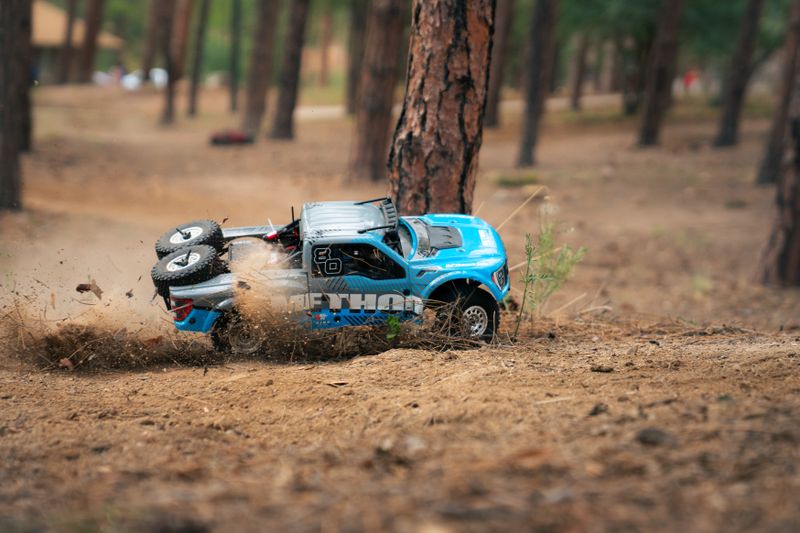
The Idea
Every RC car is already a robot body — it's got a motor, a steering servo, suspension, and a battery. The only thing making it "remote controlled" instead of "autonomous" is the receiver. Swap that receiver for a microcontroller with sensors, and you've got a self-driving vehicle.
This build works with any hobby-grade RC car (1/16 to 1/10 scale). Toy-grade cars with integrated circuits are harder to hack — stick with cars that use standard servo/ESC signals.
What You Bring
The kit includes the sensor array, motor driver interface, and GPS module. You supply:
- RC car — 1/10 or 1/16 scale, any brand (Traxxas, WLToys, Redcat — must have standard servo steering)
- Raspberry Pi 4 / 5 or Arduino Uno — Pi for camera/GPS builds, Arduino for simpler sensor-only autonomy
- microSD card — 8GB minimum (Pi builds only)
- USB battery pack or LiPo — separate power for the Pi/Arduino (RC car battery runs the motors)
What's Included in the BYOB Kit
- Triple ultrasonic sensor array (3x HC-SR04) with angled mounts
- Servo tap harness (intercepts stock steering signal)
- L298N motor driver interface board
- GPS module (u-blox NEO-6M) with antenna
- Microcontroller mounting plate (3D-printed, universal fit)
- Pre-crimped wiring harness with labeled connectors
- Complete source code, wiring diagrams, and setup documentation
What You Bring
The Full Send Kit includes all electronics and hardware. You supply:
- RC car — 1/10 or 1/16 scale, any brand (Traxxas, WLToys, Redcat — must have standard servo steering)
What's Included in the Full Send Kit
- Raspberry Pi 4B — pre-loaded with navigation software
- 16GB microSD card — pre-imaged with Raspberry Pi OS and kit software
- USB battery pack (5V/3A) for Pi power
- Triple ultrasonic sensor array (3x HC-SR04) with angled mounts
- Servo tap harness (intercepts stock steering signal)
- L298N motor driver interface board
- GPS module (u-blox NEO-6M) with antenna
- Microcontroller mounting plate (3D-printed, universal fit)
- Pre-crimped wiring harness with labeled connectors
- Complete source code, wiring diagrams, and setup documentation
Project Files — Included with BYOB Kit
Complete source code, wiring diagrams, and documentation. Enter your kit code to unlock.
Don't have a code? Get the kit — code included in every box.
Step-by-Step
Understand the Signal Chain
In a standard RC car, the receiver outputs PWM signals (pulse-width modulation) on two channels:
- Channel 1 → Steering servo: 1000µs = full left, 1500µs = center, 2000µs = full right
- Channel 2 → ESC (speed controller): 1000µs = full reverse, 1500µs = neutral, 2000µs = full throttle
Your microcontroller replaces the receiver — generate the same PWM signals, and the car obeys you instead of the remote.
Disconnect the Receiver, Connect Your Brain
Unplug the receiver from the steering servo and ESC. Connect your Arduino or Pi's PWM-capable pins to the same signal wires:
# Arduino — using the Servo library
#include <Servo.h>

// ... full implementation in project files
Add Obstacle Detection
Mount three HC-SR04 ultrasonic sensors on the front bumper — one pointing straight ahead, two angled at ±45°. This gives a roughly 90° field of view:
// Read distance from HC-SR04
long readDistance(int trigPin, int echoPin) {
    digitalWrite(trigPin, LOW);
// ... full implementation in project files
Choose Your Autonomy Level
The beauty of this build is that you can go as deep as you want:
Reactive
Ultrasonic sensors + simple rules. See obstacle → turn away. Runs on Arduino with no planning, no map. Surprisingly effective for obstacle courses.
GPS Waypoint
NEO-6M GPS + compass (HMC5883L). Define waypoints as lat/lon coordinates, drive toward each one while avoiding obstacles. Great for outdoor courses.
Vision-Based
Pi Camera + OpenCV for lane detection, sign recognition, or end-to-end neural driving. Most impressive, most complex. Look into Donkey Car for a proven framework.
Keep the Remote as a Kill Switch
Here's the clever part: wire the original receiver back in parallel with your controller using a multiplexer or RC switch channel. Flip a switch on your transmitter to instantly override autonomous mode and take manual control. Essential for testing and required for competition safety.
Tune on a Test Course
Set up cardboard boxes or pool noodles as obstacles in a parking lot. Key parameters to tune:
- Throttle speed: Start slow (1550µs). Fast is fun but you outrun your sensors' reaction time.
- Steering sensitivity: Too aggressive = oscillation. Add proportional control — steer harder when the obstacle is closer.
- Sensor range threshold: Too far = overly cautious. Too close = crashes. 30–50cm is a good starting range at walking speed.
- Loop timing: 20–50ms loop delay gives good response without sensor noise issues.
Competition Ready?
An autonomous RC car is one of the most versatile competition entries:
- Navigation Challenge: Timed obstacle course — drive from A to B avoiding barriers. The bread and butter of autonomous vehicle competitions.
- Autonomous Race: Multiple self-driving cars on a track at once. First to complete laps wins. Chaos guaranteed.
- Freestyle: Add flair — LED underglow, sound effects, a tiny trailer it's towing autonomously. Bonus points for style.
- Donkey Car class: If you go the vision/ML route, enter the AI-specific categories. Train a neural network to drive, then race it against other AI drivers.
Proven Frameworks
- Donkey Car — Open-source self-driving platform built around 1/16 RC cars. ML-based driving with Pi + camera.
- F1TENTH — Competitive 1/10 scale autonomous racing. More advanced, uses LIDAR + ROS.
- AWS DeepRacer — Amazon's ML-driven 1/18 car. Pricier but well-documented.